White House Deploys National Guard to Middle School Band Room
Officials insist the deployment is preventive. Clarinets are reportedly cooperating.
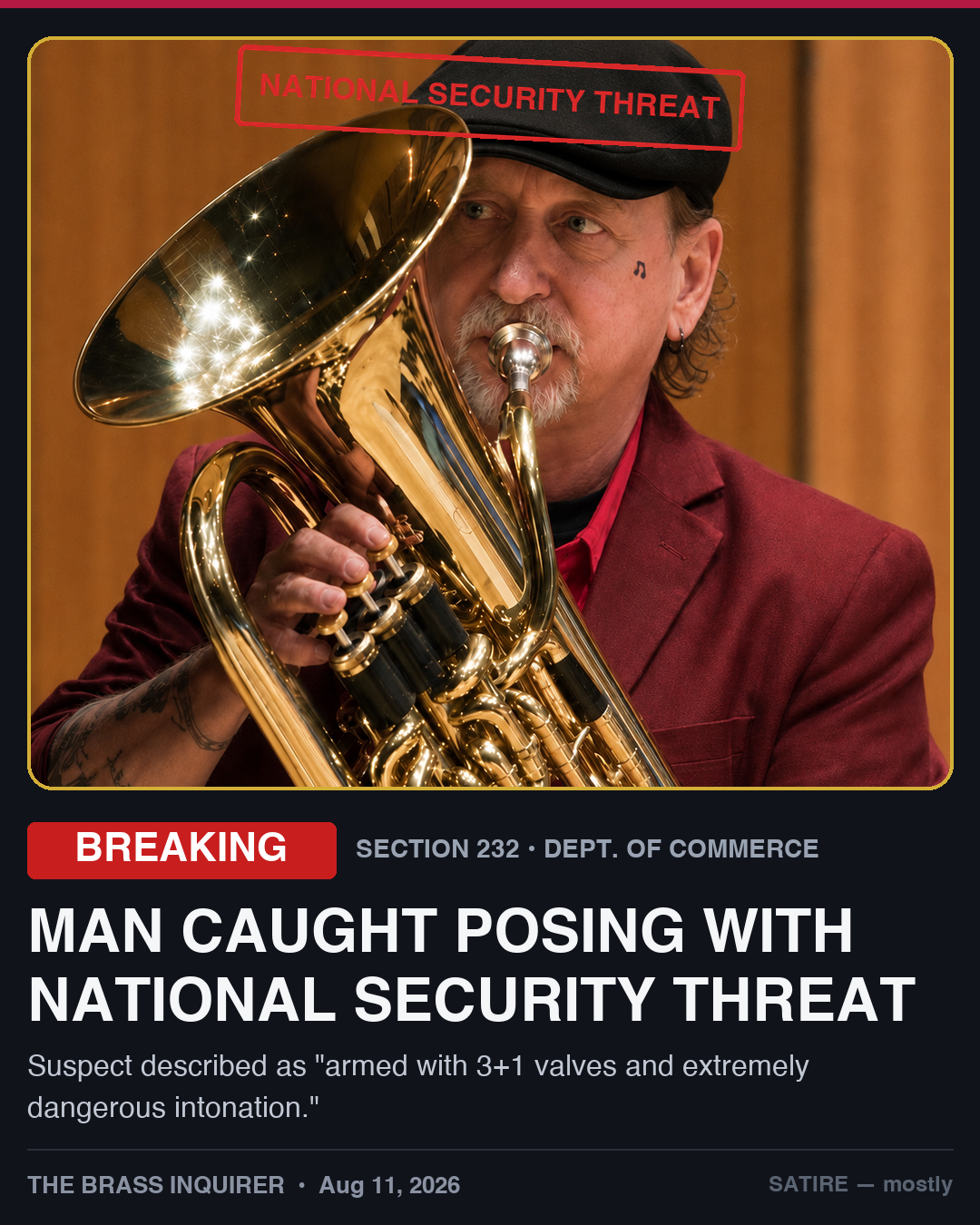
WASHINGTON — Citing “an imminent and tooted threat,” the White House today ordered National Guard units to secure band rooms at more than 400 middle schools nationwide, marking the first major enforcement action since the Commerce Department proposed designating brass-wind instruments a national security threat under Section 232.
“We will not stand by while unchecked volumes of copper and zinc are weaponized into renditions of ‘Hot Cross Buns,’” said a spokesperson, standing in front of a seized tuba displayed on a folding table like confiscated fentanyl. “Each one of these so-called ‘instruments’ contains enough brass to make — and I want to be precise here — some brass.”
Under the proposal, tubas, trumpets, trombones and French horns face tariffs of up to 50 percent, alongside fellow security threats floor safes, fire extinguishers and deodorant. Officials defended the grouping, noting that all are “metal-adjacent.”
At Jefferson Middle School, soldiers established a perimeter around the music wing at dawn. Eighth-grader Mason Reeves, 13, was briefly detained after attempting to board the bus with a trumpet case. “They asked me what was in the case,” Reeves said. “I said a trumpet. They asked what else. I said valve oil and a sandwich. They’ve got the sandwich now too.”
The National Association of Music Merchants reiterated that there is “absolutely no national security risk with musical instruments,” adding that the copper content of the entire industry amounts to “fractions of a fraction of a fraction of a percent” of national consumption. The Commerce Department responded that it would “look into these so-called ‘fractions’ and where they are manufactured.”
School band directors, long considered a stabilizing force in their communities, now face designation as “persons of interest.” “I’ve been teaching for 26 years,” said one Ohio director, speaking from an undisclosed location. “I knew the clarinets would turn informant eventually. They always do.”
Asked whether euphonium players would receive any leniency, a Pentagon official shook his head. “The euphonium is essentially a tuba with plausible deniability,” he said. “If anything, the 3+1 valve configuration suggests premeditation.”
The proposal’s public comment period remains open through August 27. A Commerce Department representative confirmed that comments may be submitted online, by mail or — in a concession to the affected community — via a single, mournful sustained B-flat.
At press time, the nation’s strategic reserves remained secure, though sources confirmed a Sousa march had been detected “somewhere in the tri-state area” and F-16s had been scrambled “just in case.”
The Brass Inquirer is a fictional publication. This article is satire. The real policy proposal it riffs on, however, is entirely genuine—which, frankly, is the whole problem.