Soloist · Teacher · Pedagogue
Brian Bowman
The dean of American euphonium — first to give a Carnegie Hall euphonium recital, longtime USAF Band soloist, and Regents Professor at North Texas.
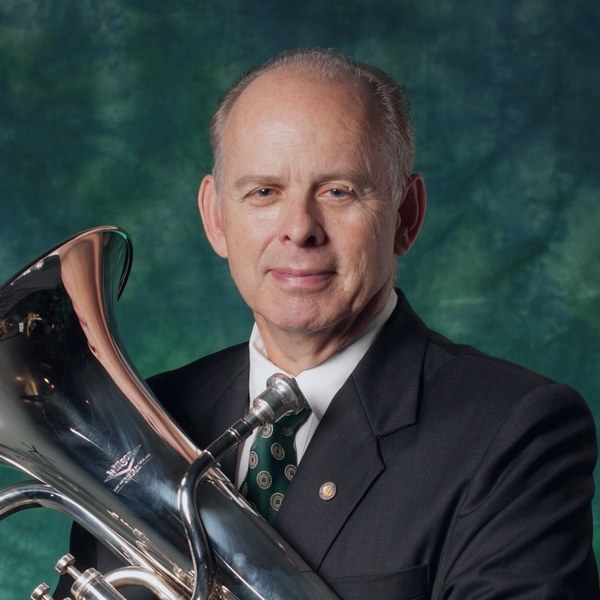
| Nationality | American |
|---|---|
| Plays | Willson · Willson design consultant (and Brian Bowman mouthpieces) |
Brian Leslie Bowman (born 1946, Fort Dodge, Iowa) is widely regarded as the most influential American euphonium soloist and teacher of his generation — often simply called the most famous euphonium soloist in the world. On 28 March 1976 he gave the first euphonium recital at Carnegie Hall, a landmark moment in the instrument’s recognition as a serious solo voice in the United States.
He studied at the University of Michigan (bachelor’s and master’s, 1970) and earned a Doctor of Musical Arts from the Catholic University of America (1975). His performing career was anchored by roughly two decades as a Washington, D.C. military bandsman: solo euphonium with the United States Navy Band (1970–74) and then the featured euphonium soloist of the United States Air Force Band, retiring as a Chief Master Sergeant. He was the first euphoniumist to serve as president of the international tuba-euphonium organization (TUBA, now ITEA).
In academia he led the brass department at Duquesne University (1992–99) before joining the University of North Texas, where he was Regents Professor of Euphonium until his 2018 retirement after nearly two decades; UNT established the Dr. Brian Bowman Euphonium Endowed Scholarship in his honor. He remains active as a clinician and teaches at institutes including the Rafael Méndez Brass Institute and the International Tuba Euphonium Institute, and has returned to the University of North Dakota for residencies alongside Joel Pugh.
Bowman shaped the instrument itself as a design consultant for the Swiss maker Willson and through his line of Brian Bowman mouthpieces, and he shaped its literature by commissioning and premiering new works. His writings — including Practical Hints for Playing the Euphonium/Baritone Horn and a bass-clef edition of the Arban method — are studio staples. Honors include British Bandsman’s Euphonium Player of the Year (1989), the TUBA Lifetime Achievement Award (1995), the Clifford Bevan Award (2010), and the American Bandmasters Association’s Edwin Franko Goldman Memorial Citation (2016); he is the only living euphoniumist profiled in Michael Meckna’s Twentieth-Century Brass Soloists.